 Bahasa Indonesia
 English
Applying Community Psychology and Healthy Habit Formation: UNY Psychology Students Initiate the DARMA BUMI Movement in Banjaroyo
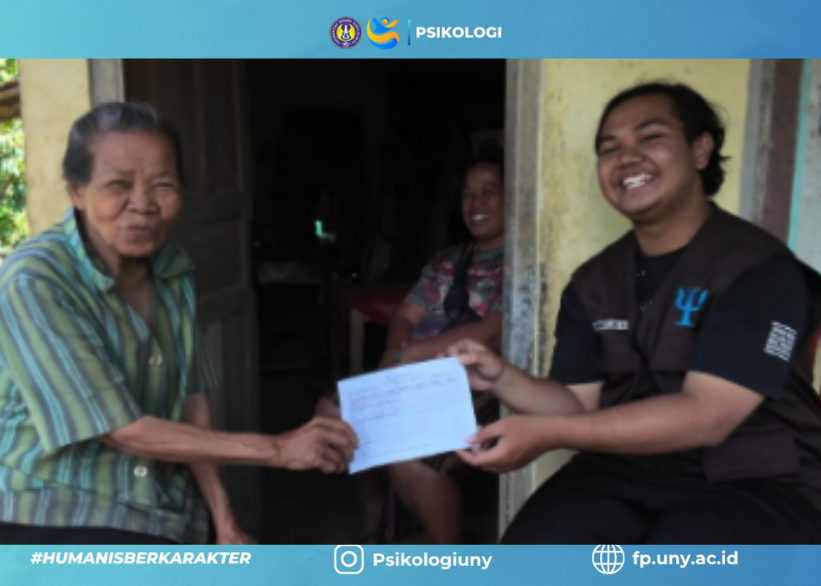
The PPK Ormawa team from BEM KM Psychology at Universitas Negeri Yogyakarta (UNY) 2026, alongside Agenpsy volunteers, initiated a community empowerment program titled DARMA BUMI in Duren Sawit Hamlet, Banjaroyo Village, Kalibawang District, Kulon Progo Regency. Centered on the "1 House 1 Jumantik" movement, the program integrates principles of community psychology and behavioral intervention to foster independent healthy habit formation in preventing Dengue Hemorrhagic Fever.
From the perspective of health psychology, sustainable lifestyle changes require effective self-monitoring mechanisms. By distributing and educating residents on a self-monitoring larvae checklist, the student team introduced a visual prompt that guides families through routine water container inspections. This approach gradually shifts the community's mindset from reactive responses to proactive behaviors in detecting and eliminating potential mosquito breeding sites early on within their domestic space.
Beyond individual and household interventions, the DARMA BUMI program leverages group dynamics through communal cleanup drives alongside local health cadres and residents. This collective action aims to strengthen collective efficacy, which is the shared belief within a community that it can independently manage and resolve its health challenges. As facilitators, undergraduate psychology students created an interactive dialogue space that cultivated trust and active participation across all social layers.
Furthermore, the program aligns its initiatives with the Sustainable Development Goals (SDGs). Applying health psychology to domestic dengue prevention supports SDG 3 regarding Good Health and Well-being. The field engagement serves as an experiential learning environment for psychology students to apply Community Psychology frameworks, directly advancing SDG 4 for Quality Education. Establishing self-sufficient neighborhood sanitation supports SDG 11 for Sustainable Cities and Communities, while multi-stakeholder collaboration among students, youth volunteers, cadres, and local authorities fulfills SDG 17 for Partnerships for the Goals.
For undergraduate psychology students at UNY, the DARMA BUMI initiative in Duren Sawit Hamlet serves as a valuable social laboratory to observe how local social norms and communication structures influence community risk perception. Through sustained engagement and humanistic psychological approaches, the program aims to cultivate a collective consciousness, proving that small, consistent actions initiated within every household can build a healthy, safe, and dengue-free environment.

Contact Us

Faculty of Psychology
Yogyakarta State University
Colombo Street Number 1
Karangmalang, Sleman, Yogyakarta 55281
Indonesia
Email: humas_fp@uny.ac.id, sekretaris.dekanfp@uny.ac.id
Instagram: @psikologiuny